Repertoire
How to Tell If a Piece Will Be Too Big for Your Hands
Most of us pick a piece by how it sounds. Three weeks in, we hit the bar that does not fit our hand, and we either drop the piece or learn it with a workaround. A five minute look at the score first saves that.
Four things to look for
- Chords wider than an octave. A tenth spans 10 white keys, and Romantic piano music has plenty of them. A hand that tops out at an octave, 8 keys, has to roll them.
- Runs of octaves. The left hand in Beethoven's Pathétique is the classic case, where rapid octaves keep the hand stretched for bar after bar.
- Big leaps. Liszt's La Campanella is the textbook example: the hand has to cross the keyboard again and again. Brenda Wristen and Lora Deahl write that small-handed players should use their arms to find the notes on big jumps and not reach with the fingers, and that this takes a lot of practice purely for the sake of accuracy.
- Dense chords with inner notes. When a chord has four or five notes and your hand cannot cover them, the middle voices are the ones that get dropped.
A five minute check
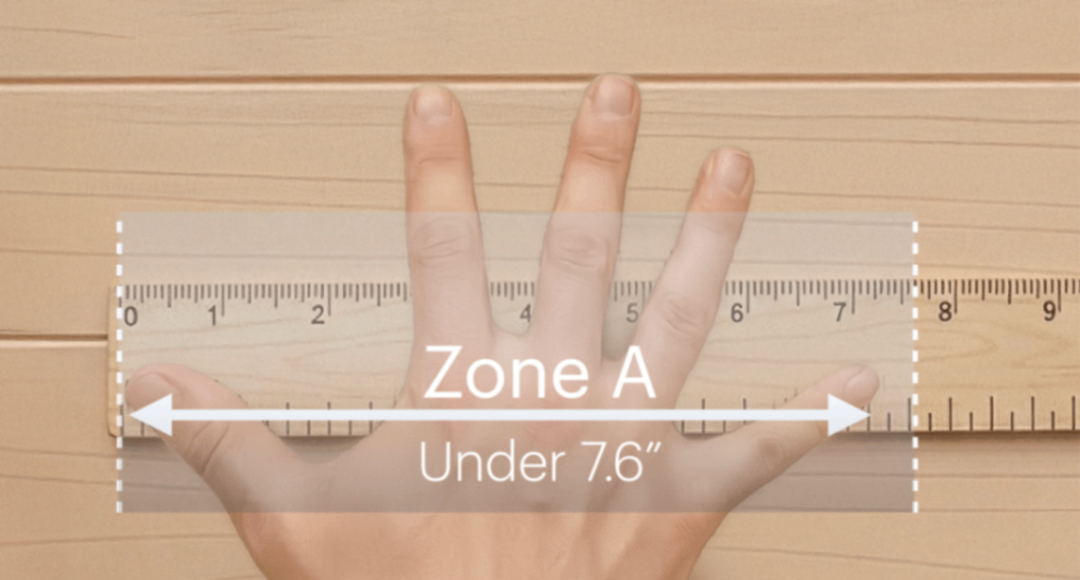
For a sense of scale, a hand that reaches 8 white keys can play an octave, 9 keys a ninth, and 10 keys a tenth. Count the white keys under your widest chord and compare that number with your own reach. Then find the widest chord and the widest stretch in each hand, and play each one once, slowly, with no pedal. Mark the ones where your hand flattens, your wrist tips toward your little finger, or your little finger lands on the key edge. Then count the marks.
A rule of thumb: one or two marks in a piece is a fingering problem, and you can solve it. A mark on nearly every page is a hand size problem, and it is better to know that before week three than after it.
Three fixes for a stretch you cannot reach
When a mark turns up, you have three honest options before you give up on the piece:
- Roll the chord, as lightly and as quickly as the music allows, so the notes you cannot press together still sound like one chord.
- Share the notes between the hands. If the left hand cannot cover a wide chord, the right hand can often take the top note.
- Drop a note. When you have to drop one, drop an inner note, because the outer notes carry the bass and the melody and the middle voices are the ones the ear misses least.
Try them in that order, and write the fingering into the score in pencil, so next week's version of you does not have to work it out again.
Rolling is allowed
Rolling a chord, re-voicing it, or sharing notes between the hands is a normal pianist's tool. You will be amazed at the number of piano teachers who say hand size does not matter and then, in the same lesson, tell a student to use a different fingering or roll the chord because it fits their hand better. Use the tools. Just know which of your workarounds are fingering choices, and which are your hand telling you the keys are too wide.
And keep the composer in mind. Rachmaninoff could play a twelfth, and he wrote for that hand. If one of his chords does not fit yours, that is geometry, and it tells you nothing about your talent.
What I would do next
Pick the piece you want most, run the check, and decide: roll it, re-voice it, or save it for later and choose another one for now. A piece you can play comfortably this month is a better use of the month than one you wrestle with and quit.
Lionel
P.S. Our page on the benefits of practicing on narrower keys has a video of me demonstrating technically demanding repertoire on a DS6.0, and it goes through these same problems: Rachmaninoff chords, octave runs and leaps.
See what changes on a narrower keyboard
Our page on practicing on narrower keys goes through Rachmaninoff chords, octave runs and big leaps.