Hand Size
How to Measure Your Piano Hand Span (and What It Means)
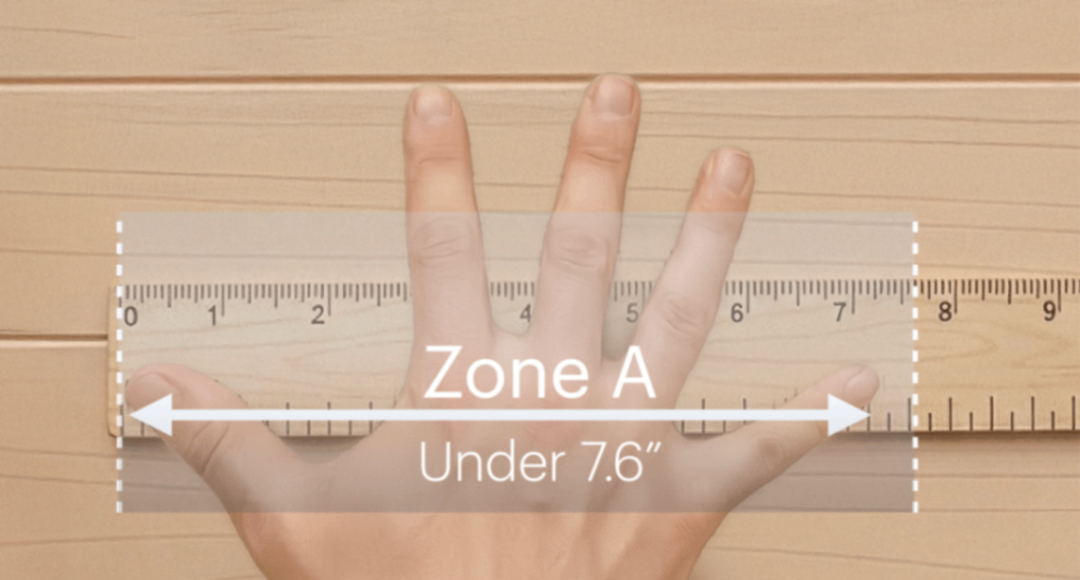
So here is the one number that decides how a standard piano feels in your hands: your hand span, which is the distance from the tip of your thumb to the tip of your little finger when you spread your hand wide. It takes a ruler and about two minutes, and it explains more about your octaves and chords than most people expect.
How to measure it
- Lay a ruler flat on a table with the zero at the edge, and rest your hand on it, palm down.
- Put your thumb tip on the zero and spread your little finger out as far as it goes comfortably, stretched naturally and not forced.
- Read the number at the tip of your little finger. Inches are the easiest, because the keyboard sizes below are in inches.
- Do it three times with each hand, and write down the biggest comfortable number for each.
Don't pull your fingers wider with your other hand. If you have to push to get a bigger number, it is not a number you can play with.
If you would like it all in one place, the homepage has a free Hand-Measuring Guide you can download. It walks through the same steps and shows which zone, and which keyboard size, goes with your number.
What the number means on a standard keyboard
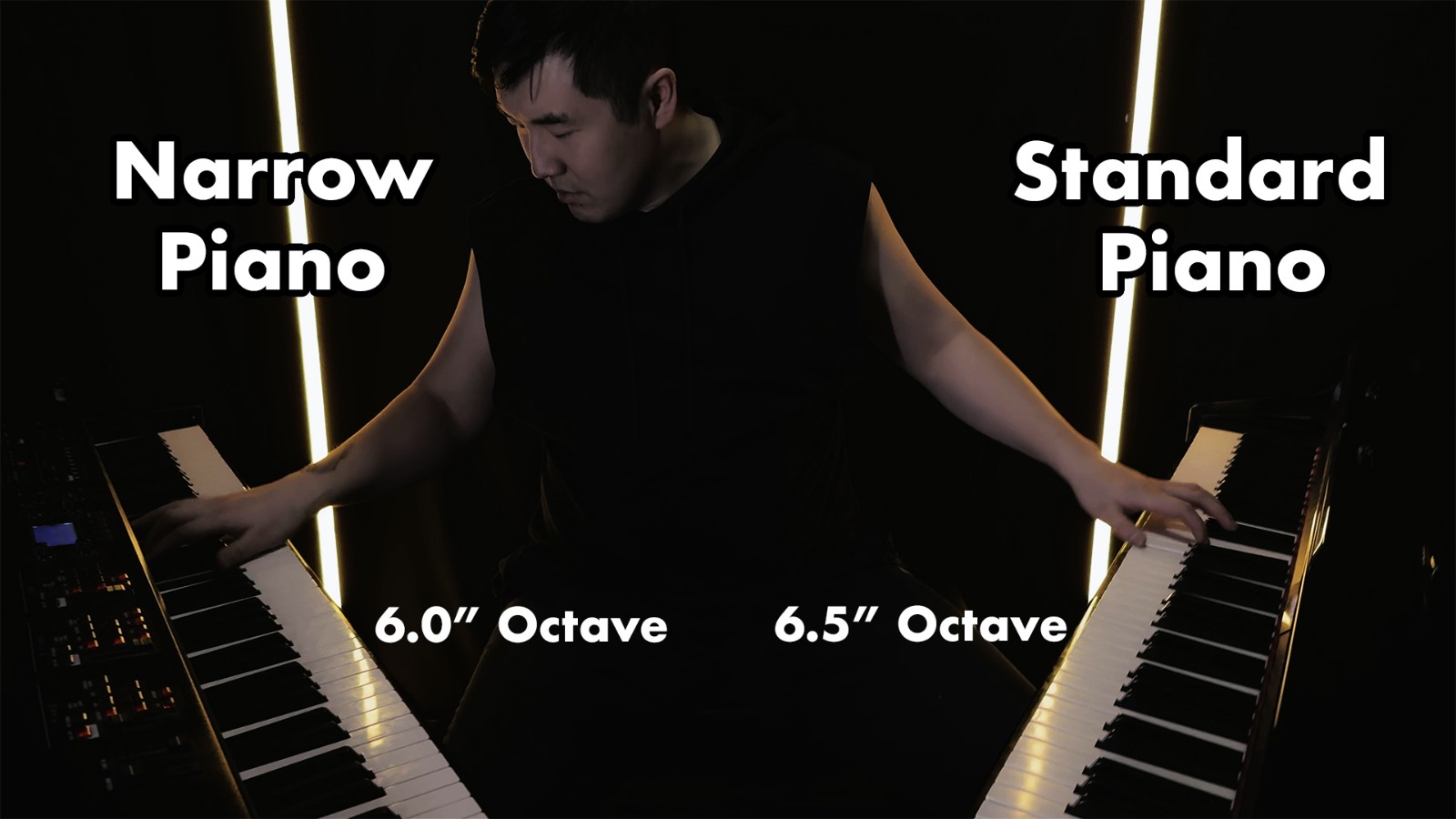
A standard keyboard has a 6.5 inch octave, and the group Pianists for Alternatively Sized Keyboards (PASK) puts the minimum span for playing it comfortably at 8.5 inches. Their data says that 87.1% of adult women and 23.8% of adult men are under that line, which is why we use 8.5 inches as the dividing line on our site too.
There is a second rule of thumb that shows where 8.5 comes from. To reach 8ths, 9ths and 10ths without strain, your span often needs to be 25 to 30 percent bigger than the octave itself. Take a 6.5 inch octave, add 25 to 30 percent, and you land right around 8.5 inches.
The three zones
We sort hand spans into three zones, and each one has a keyboard size that fits it:
- Zone A is a span under 7.6 inches, and the fit is a DS5.5, which has a 5.5 inch octave.
- Zone B is a span from 7.6 to 8.5 inches, and the fit is a DS6.0, which has a 6.0 inch octave.
- Zone C is a span over 8.5 inches, and a standard 6.5 inch octave is fine.
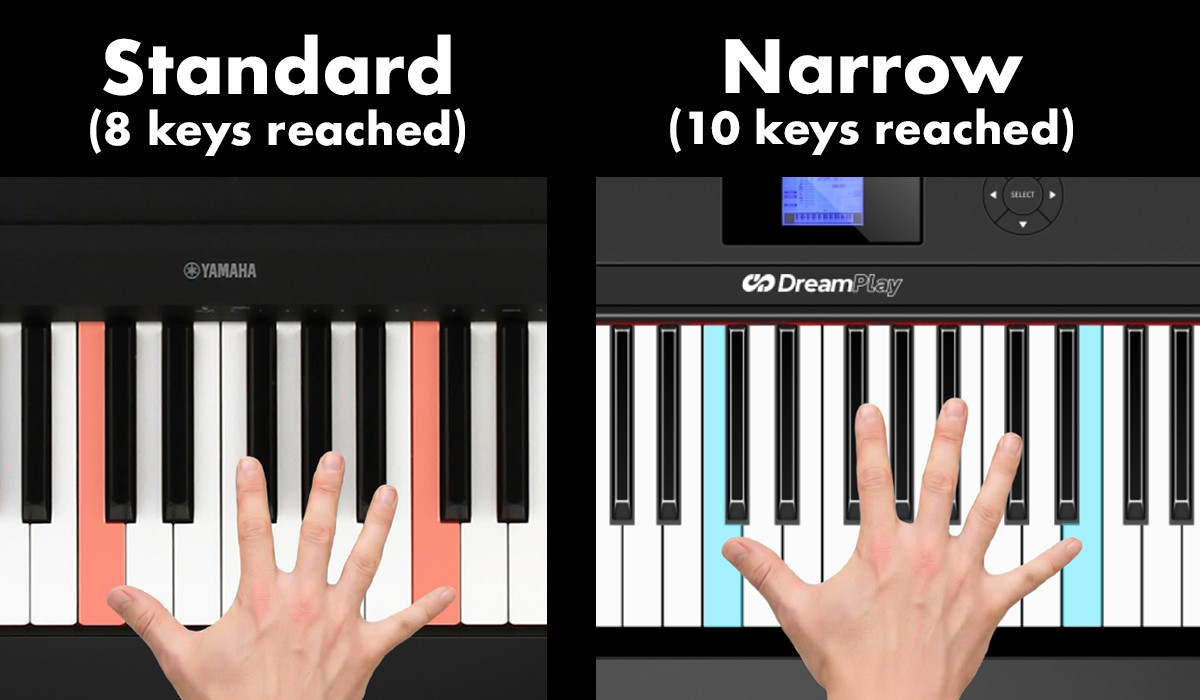
Here is what that looks like at the keys. A Zone A hand reaches 8 white keys on a standard keyboard, which is an octave, and 10 white keys on a DS5.5, which is a tenth. A Zone B hand reaches 9 on a standard keyboard and 10 on a DS6.0.
A number is not a verdict
Treat the ruler as a starting point. Two hands with the same span can feel different at the keys, so also try it where it counts: play an octave, then a tenth, slowly, with no pedal. If your fingers flatten out, your wrist tips toward your little finger, or your little finger lands on the very edge of the key, that is your hand telling you the keys are wide for it.
I play a DS6.0 myself. My hands are not large, especially for a man, and I spent almost 30 years stretching on standard keys before I understood that the problem was never my technique. I wish somebody had handed me a ruler a lot earlier.
Measure both hands tonight and stick the numbers on a note on your music stand. The next time a score asks for a tenth, you will know which side of the line you are on.
Lionel
P.S. If you would rather skip the ruler, our Buyer's Guide asks 4 questions and recommends a size, in about 2 minutes.
Not sure which zone you are in?
Our Buyer's Guide asks 4 questions and recommends a keyboard size. It takes about 2 minutes.